TV and Radio Ordered to Cease Live Protest Coverage Amid Gen Z Demos
The Communications Authority of Kenya (CA) has issued a directive requiring all television and radio stations to immediately cease live coverage of the ongoing June 25 anniversary protests. In a letter dated June 25, 2025, CA Director General David Mugonyi cited legal violations as the basis for the directive. According to the Authority, live broadcasts […]

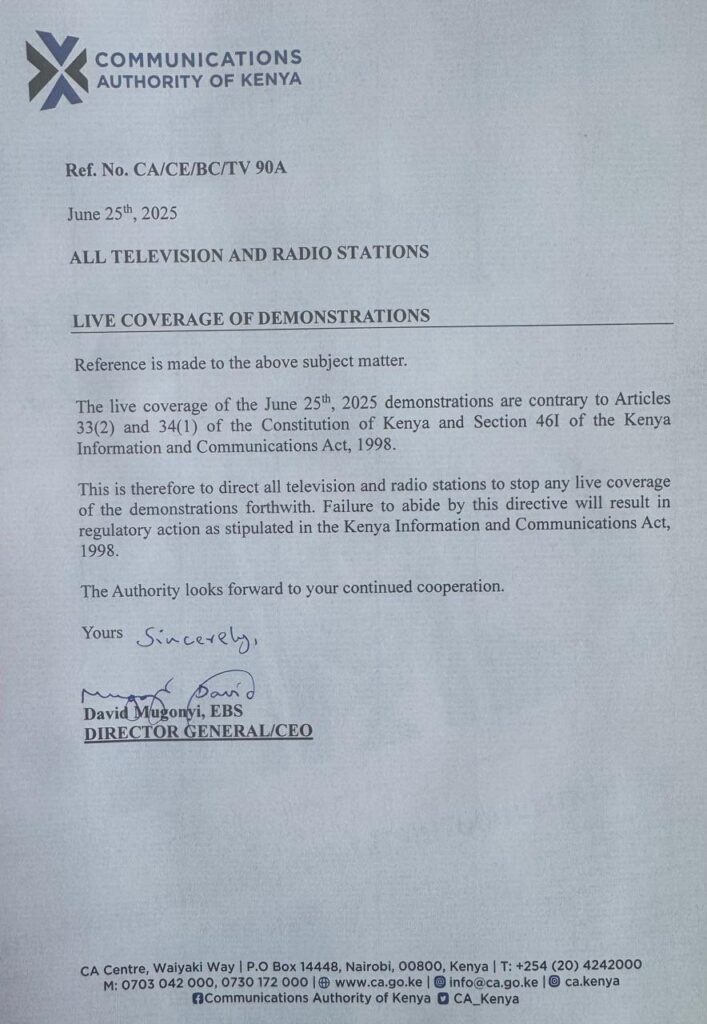
The Communications Authority of Kenya (CA) has issued a directive requiring all television and radio stations to immediately cease live coverage of the ongoing June 25 anniversary protests.
In a letter dated June 25, 2025, CA Director General David Mugonyi cited legal violations as the basis for the directive. According to the Authority, live broadcasts of the demonstrations contravene Articles 33(2) and 34(1) of the Constitution of Kenya, as well as Section 461 of the Kenya Information and Communications Act, 1998.
“The live coverage of the June 25, 2025 demonstrations is contrary to Articles 33(2) and 34(1) of the Constitution of Kenya and Section 461 of the Kenya Information and Communications Act,” the directive stated.
The Authority cautioned that any media outlet defying the order would face unspecified regulatory consequences.
“All television and radio stations are directed to stop any live coverage of the demonstrations forthwith. Failure to abide by this directive will result in regulatory action as stipulated,” the statement added.

This move comes as thousands of protestors—primarily from the Gen Z demographic—continue to take to the streets across Nairobi and other major towns, marking the anniversary of the June 25, 2024 protests. Last year’s anti-Finance Bill demonstrations left dozens dead and many others injured, prompting renewed demands for justice, police accountability, and governance reforms.
The CA’s decision marks the first time the Authority has openly ordered a nationwide blackout on live protest coverage. In contrast, media outlets were able to provide uninterrupted live coverage during the 2024 protests without government interference.
The directive is expected to draw sharp criticism from media freedom advocates, civil society organizations, and opposition leaders, many of whom may interpret it as an attempt to limit press freedom and deny the public access to real-time information during a national moment of reckoning.
Reporter
0 Comments
Leave a Comment